
What’s in this playbook
- Buyers go quiet during winter, not absent. RV usage is up 50% since 2021 (30 days a year, up from 20), and most buyers research a dealer’s site three to five times before ever calling — proof that shopping continues through the gap even when showroom traffic doesn’t.
- The gap is prep time, not downtime. Dealers who win show season use November and December to lock in show spots, build search campaigns, and get listings and service content in order — not the ones who wait until January to start.
- Used inventory doesn’t take a holiday. Used-unit interest runs on its own calendar and often spikes during economic pressure, so it shouldn’t slow down just because new-unit traffic does.
- Small, low-cost moves compound. Service-page SEO, smarter email cadence, and simple in-person touches like a fast winterization appointment all cost next to nothing and set up a stronger January.
You already know the rhythm. September and October are still humming along, showroom traffic and phone calls carrying real weight all the way to Halloween. Then things go quiet for a stretch. Then January hits and show season kicks back in, and suddenly you’re back to full speed.
What’s worth a hard look is that two-month gap sitting right in the middle (November and December) and what you do with it.
Most dealers treat that stretch as something to get through. Answer the calls that come in, keep the lights on, wait for January. For plenty of dealerships, “keep the lights on” is generous, because the doors close outright for a week or more around the holidays. Staff take time off, the showroom locks up, and the dealership genuinely goes dark for a stretch. That’s a completely reasonable way to handle the gap, holiday closure included. It’s just not the way to win it.
The dealers who come out of show season strongest aren’t the ones who worked harder in January. They’re the ones who set things up in November — campaigns, listings, service content — that keep working even while the showroom itself is closed for the holidays, so that by the time buyers show up ready to compare specs and financing, everything’s already in place.
This is the playbook for that two-month stretch: what real usage and search data says is happening in November and December even when your lot feels quiet, why buyers are still in the mix during those months, how to read your own market’s version of the gap instead of assuming it looks like everyone else’s, and a concrete set of moves that turn that downtime into a real head start.
What Should RV Dealers Do During the November–December Slowdown?
Here’s the honest split we see across the dealer landscape. Some dealers spend November and December coasting: fewer calls, so less gets done, and everything picks back up “whenever January gets here.” Other dealers spend that exact same stretch locking in show season booth space, finishing search campaigns, and getting their service departments and listings in order, so that January isn’t a scramble, it’s a launch.
Both groups are looking at the same calendar. Only one of them is using it.
We heard this directly from our Customer Success team, who work hands-on with RV dealers across the country every day: the dealers who come out of show season strongest are the ones who treat November and December as prep time, not downtime. They’re securing their spots for January-through-March show season during those two quiet months, locking in booth placement, planning their own on-site sale events, and building out search campaigns aimed at buyers who are already comparing specific year, make, and model combinations. By the time show season opens, those buyers are basically just price-shopping between dealers, and the dealer whose campaign has been live since December is the one who gets the call.
“People are still out there searching in November and December — they’re just not buying yet. That’s exactly what feeds your spring season.” — Lauren Librizzi, Sr. Regional Marketing Director, InteractRV, 10 Years of Experience
The two-month gap isn’t dead time. It’s the runway. What you do with November and December determines whether January feels like a running start or a cold one. That’s true regardless of who’s walking through your door today, though it’s worth knowing that the buyer doing that searching looks a little different than they used to, which is exactly what we’re covering in our next piece.
What Does the Data Say About RV Demand in November and December?
Let’s ground this in numbers, because the case for using the gap isn’t a hunch. It’s a pattern that shows up everywhere you look.
Start with usage. The median RV owner is now using their unit about 30 days a year (up from 20 days back in 2021). That’s a 50% jump in just a few years. Owners are also reporting an average of nine trips a year, at a median distance of 250 miles per trip. That’s not one big summer haul anymore. That’s frequent, shorter trips spread across a much wider window than Memorial Day to Labor Day ever accounted for, which is part of why fall carries real momentum right up until the gap hits. Industry wholesale data tells a similar story: roughly 2.5% year-over-year growth in shipments, with a meaningful share of that tied to demand extending well past the traditional end-of-summer cutoff.
Your own website is telling a version of this story too, whether you’re watching or not. Inventory is up 1.64% industry-wide this year, and more than 54% of dealership website traffic now happens outside business hours. Shopping doesn’t pause just because your showroom does. And the research cycle behind that shopping isn’t a quick glance, either — most buyers are visiting a dealer’s site three, four, even five times before they ever pick up the phone, a cycle that plays out over weeks, not days, which lines up perfectly with a buyer doing their homework across a quiet November and December before calling in January.
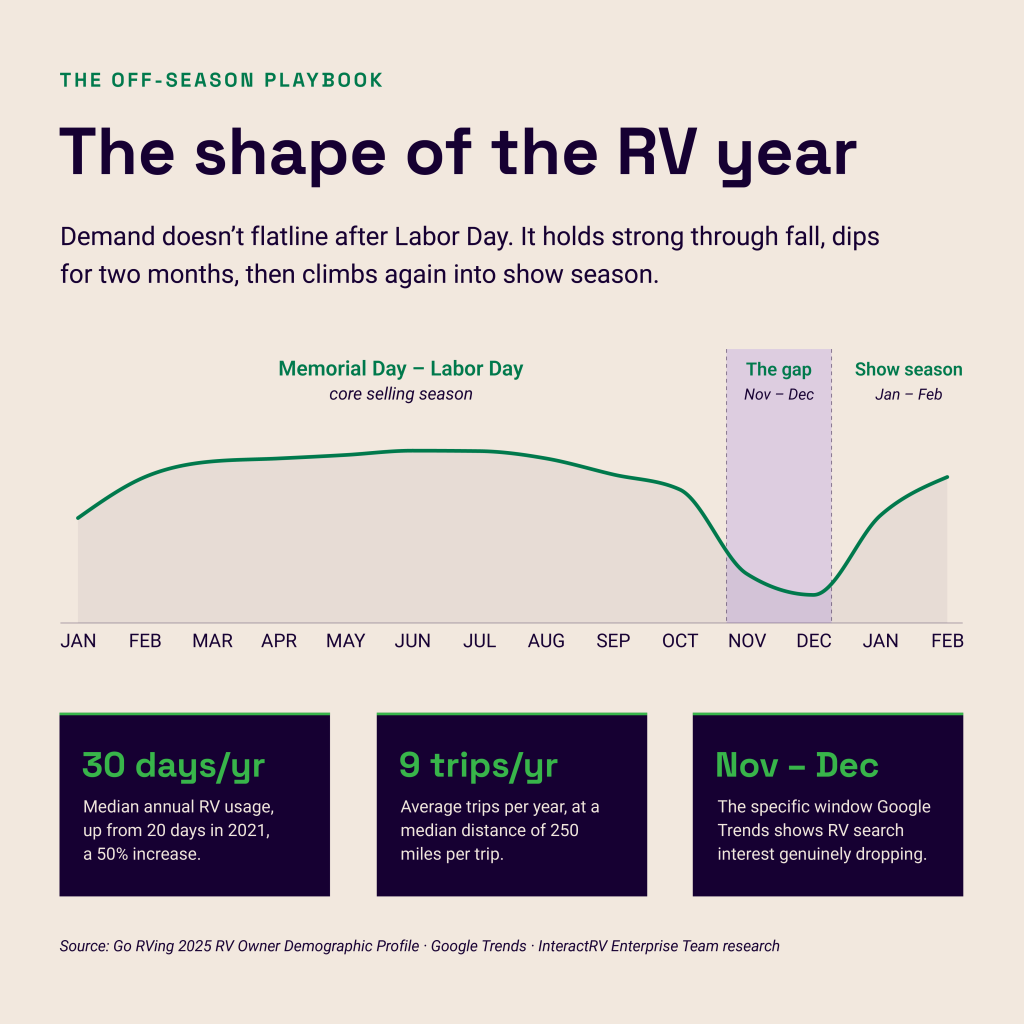
Our own website data shows a real dip in RV search volume through November and December specifically, before it starts climbing back as January approaches. The demand dip is real. The attention dip most dealers assume is often bigger in their heads than it is in the data.
“Dealers running the right supplemental campaigns during the gap see a noticeably smaller drop in their own site traffic than the broader trend line would suggest.” — Nate Randall, Regional Marketing Director, InteractRV
And then there’s used inventory, which barely acknowledges the gap at all. Used units don’t follow the same curve as new ones; it’s a wider, less predictable buying window all year, closer to a hunting-season pattern for rougher, as-is units than a strict spring-to-summer rush. Used-inventory interest also tends to spike during periods of economic pressure: downturns, rising gas prices, election years. Budget-conscious buyers still want the RV lifestyle, they just shift toward affordability to get there, and that shift doesn’t check a calendar first.
“Used inventory can be profitable at every stage — when you acquire it, when you sell it, and again through financing. Dealers who lean into it well can even pull service business away from the bigger chains nearby.” — Liz Lancaster, Regional Sales & Marketing Director, InteractRV
Put it together and the takeaway is simple: November and December are quieter, no argument there, but quieter isn’t the same as empty, and the data backs that up every time.
Why Are RV Buyers Still Active During the Off-Season?
So why does anything happen at all during the two flattest months on the calendar?
The obvious factor is the holidays themselves. Family gatherings are exactly when big future purchases get talked about — “we should finally get one this year,” said over a table in late November, is a real sentence that happens in real households. That conversation doesn’t turn into a sale in December. It turns into three people quietly researching floor plans over the following six weeks, which is precisely the multi-visit research cycle showing up in your own site data. The dealer who’s easy to find and easy to talk to in December is the one that conversation eventually leads back to.
Then there’s the calendar itself, or rather, the disappearing grip it used to have on people’s schedules. Remote work and flexible hours mean fewer RVers are locked into a rigid, school-year vacation window, which means the planning and researching that used to happen only in spring now happens whenever someone has a quiet evening, including a Tuesday in early December. That shift connects directly to a buyer segment we’ll dig into properly in our next piece, but the short version is this: the RVer researching tonight might be planning a trip for March, and there’s no reason that research should wait until the calendar says “spring.”
Used inventory adds its own layer here. Buyers motivated by affordability, financing, or trading in an older unit aren’t waiting for show season to start thinking about it — if anything, tighter household budgets around the holidays make that used-unit conversation more relevant in December, not less.
None of this means November and December feel busy. They don’t, and they’re not supposed to. It means the people who’ll walk into show season ready to buy are, right now, quietly doing the work that gets them there — and the dealer who shows up well in that quiet research phase has a real head start once January arrives.
How Does the RV Off-Season Vary by Region?
Here’s where it gets specific, because the two-month gap doesn’t look identical everywhere. It’s regional, and it’s honestly a little unpredictable year to year.
Snowbird markets, such as Florida, Arizona, and Texas, see a much shallower dip than colder markets like New York, Michigan, Minnesota, or Utah, where November and December can bring things closer to a full stop. That much probably isn’t a surprise. What’s easier to underestimate is how much weather itself, not just geography, can scramble even a market that usually holds up well. A market with a strong show season lined up can still lose a meaningful chunk of December to a single week-long winter storm. The gap isn’t a fixed line on a map. It’s regional and weather-dependent, and it shifts a little every year.
So, before you assume your gap looks like the generic industry pattern, run your own honest check. Look at your local climate. Pull up your historical service bay traffic month by month — that data will tell you the truth even when gut instinct won’t. Check your regional trade show and event calendar. All three together will tell you how deep and how long your November–December gap really runs, which might be shorter or longer than the pattern above.
If you ran the two-hour website audit heading into summer, this is the moment to run a version of it for the gap. Same honest questions, different context: is your market genuinely quiet right now, or is it quiet on the surface while your buyers keep researching in the background?
How Can RV Dealers Turn November and December into a Head Start on Show Season?
This is the part you can act on today. Here’s how to spend the two quiet months so January opens strong instead of scrambling to catch up.
Use the gap to lock down show season; don’t wait for January to start prepping.
The dealers who come out of show season strongest are securing their spots, booking on-site sale spaces, and setting up search campaigns aimed at buyers already comparing specific year, make, and model combinations — all before January opens. Those buyers show up ready to buy. A campaign that isn’t already running when they start looking is a campaign that misses them. This isn’t just paid search, either. It’s booth placement, it’s early-bird advertising rates, it’s getting first pick of the good real estate at the multi-dealer show before your competitors lock it up.
Keep used-inventory messaging running at full strength.
Used inventory runs on its own, less seasonal window, and interest in it doesn’t dip just because the calendar says November. Treat it as its own campaign on its own timeline through the gap, not something that pauses alongside new-unit marketing.
Separate event prep from event promotion.
The planning and logistics for a show or an on-site sale should start well before the gap even begins. The marketing push shouldn’t. The effective promotional window for an event is closer to one to two weeks before it happens. Push too early and the message gets lost in the noise; a well-timed reminder close to the date beats a distant save-the-date every time.
Match your ad spend to the calendar, not to habit.
You don’t need to out-bid bigger competitors on search through the gap, when conversion is down industry-wide regardless of budget. Shift some of that spend toward lower-cost, broader-reach channels such as display and social while things are quiet. Those channels typically cost less per impression than a search ad chasing the same handful of high-intent keywords, so the same budget buys a lot more frequency. You’re buying visibility per dollar during the gap, not an immediate conversion, and that visibility is exactly what keeps your funnel warm for show season.
Don’t go dark. But don’t overdo it either.
Silence can cost you the momentum you’ll have to rebuild from scratch come January. But emailing an unresponsive list for six-plus weeks straight has a cost of its own: a one-way ticket to the spam folder that hurts your deliverability long after the gap ends. The fix is variety, not volume. Rotate your call to action between new and incoming inventory, service reminders, and parts, instead of leaning on a sales pitch every single time.
Treat service as a marketing surface, not just a cost center.
This one’s close to free, and the gap is the perfect time to build it. Put together dedicated pages for each service type you offer (winterization, A/C repair, collision repair, whatever fits your shop) with FAQs written in the same plain language both your customers and today’s AI-driven search tools are looking for.
“Hand us the content your service department already has, and it costs almost nothing but a little effort to turn that into real SEO value.” — John White, Account Director, InteractRV
Turn winterization into a relationship touchpoint, not just a work order.
One idea worth borrowing directly: consolidate winterization into a handful of dedicated days, promote it as a fast, in-and-out appointment, and add a small in-person comfort touch: hot cocoa in the showroom while customers wait, something that simple. It costs almost nothing, and it turns a routine gap-season service stop into something a little more personal, a few minutes of conversation you wouldn’t otherwise get. A catchy, weather-themed name for a bundled service-and-parts promotion (“cold weather, hot deals”) works the same way, giving your gap-season pitch a hook instead of a generic “we’re still open” message.
Keep your listings and lead-response habits sharp, even when traffic feels quiet.
The fundamentals matter just as much during the gap as they do in July: complete pricing, enough photos, a fast after-hours response. Buyers are still comparing you against several other dealers before they ever reach out, and a thin listing in December costs you the same lead a thin listing would cost you in June.
Actively collect email addresses at every single in-person touchpoint, not just at the point of sale.
Your email list decays on its own whether you touch it or not — ZeroBounce’s most recent data puts typical annual database decay at roughly 23%, mostly from addresses that change or simply get abandoned. If you’re not actively collecting new addresses at the sales desk, the service counter, and the parts window, you’re quietly losing the exact channel this whole playbook leans on to stay present through the gap.
Use the quiet stretch to invest in the relationship, not just the next sale.
RV owners hold onto a unit anywhere from about 5 to 20 years, depending on where they are in their ownership journey. That means the gap is part of a relationship that’s going to run a lot longer than any single sale, and it’s genuinely easier to invest in that relationship when the phones aren’t ringing off the hook.
“Staying loyal to your customers after the sale is a lot cheaper than trying to win their attention back with ads later, and the bigger a dealer group gets, the more likely they are to drop the ball there.” — John White, Account Director, InteractRV
That’s the list. None of it requires a bigger budget than you’re already working with. Most of it just requires deciding the gap is worth using instead of waiting out.
So, What Will You Do With Your Next Two Months?
You already knew November and December would be quiet. That was never the question. The question is whether that quiet turns into two wasted months or two months of real preparation.
Knowing what to do with that gap is only half the picture, though. The other half is knowing who’s on the other end of it — because the RVer doing that quiet research this December isn’t quite the same RVer who did it a decade ago, and that shift changes more than just your seasonal strategy.
And since that research is happening quietly and largely online, it’s worth understanding how differently buyers are searching now and how much a faster response can be worth once they finally do reach out. More on both, soon.
For now, do one thing before you close this tab: pull up your own service-bay traffic and site analytics from the last few Novembers and Decembers. See for yourself how much is really happening in the background while your lot feels quiet.
