



Blog
They’re younger, they shop alone at night, and they may be the buyer your used lot has been waiting for. Here's how to find them, earn them, and keep them.
It's 9:14 p.m. on a Tuesday night. Your lot is dark, your team is home, and a 32-year-old with a toddler asleep down the hall is searching through your bunkhouse listings. Whether they call you in the morning depends on what they find on those pages. More than half of dealer traffic (54.06%) happens outside business hours, so this is happening on your site tonight.
Every dealership has a mental picture of who walks through the door. For a long time, that picture was remarkably consistent: a retiree, financially settled, buying the RV they'd been planning for since their last kid left the house. That buyer still exists, and they still matter. But they are no longer the whole story, and dealerships still building their entire strategy around that one picture are missing the fastest-growing, most adventurous part of today's market.
The buyer you can't seem to reach and the buyer who would clear your used lot are often the same 32-year-old. Reach them once, and you solve two problems with one strategy.
This article covers who that buyer is, why they overlap so heavily with your used lot, where and how to find them, what they expect once they do, and how to turn all of it into a strategy that holds up across every quarter of the year, not just the busy one.
Who is today's RV buyer, really?
The data is more dramatic than most dealership sales meetings give it credit for:
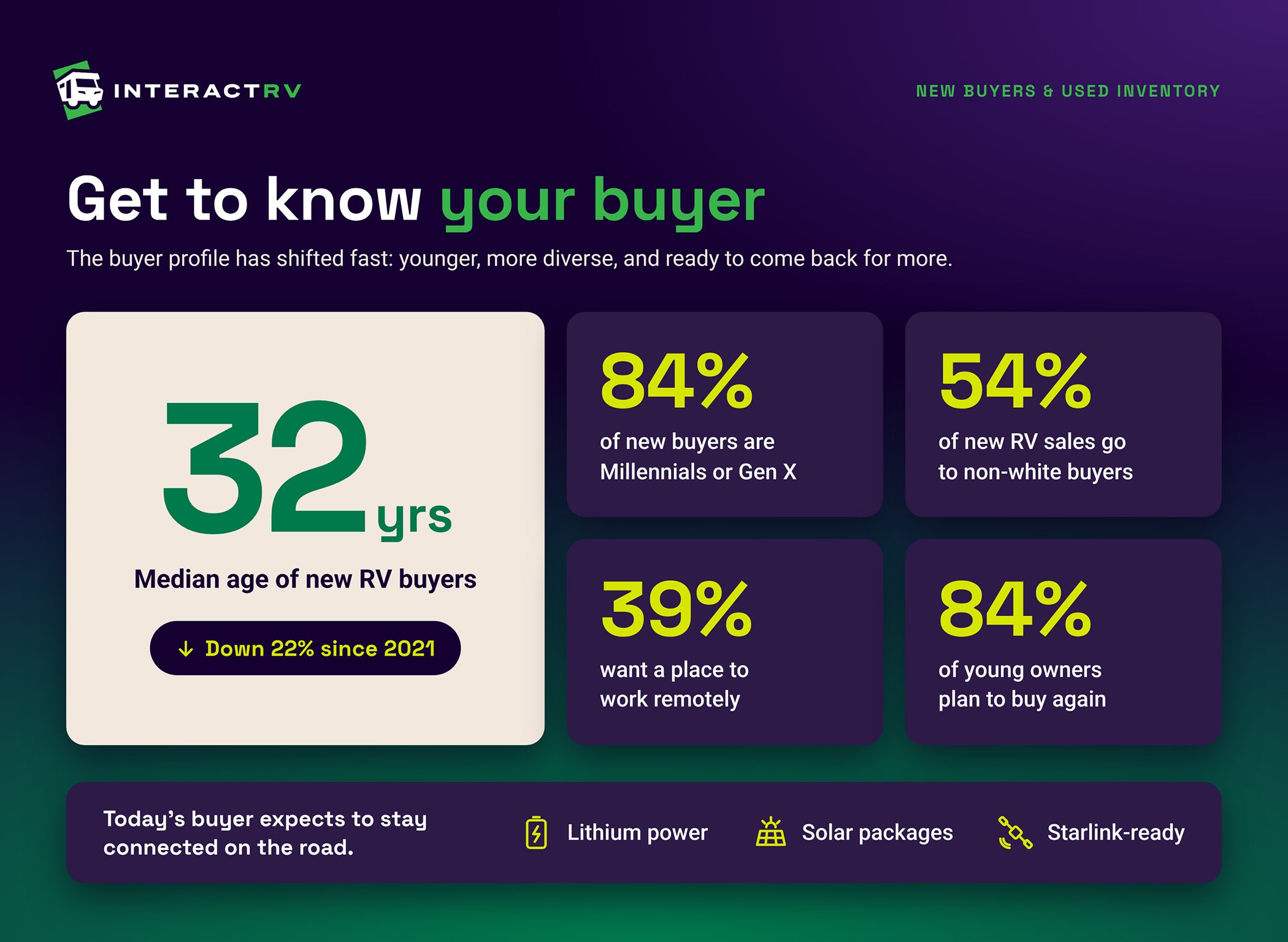
- The median age of new RV buyers is 32, down 22% since 2021. Picture someone with a toddler, a student loan, and a 10 a.m. video call they'd rather take from a campsite outside Moab.
- Millennials and Gen Xers now make up 84% of new RV buyers, having overtaken every other generation combined by more than double.
- 84% of current 18–34-year-old owners plan to buy another RV (78% of those planning to buy new). Picture the couple who bought a used teardrop in 2022, already eyeing a bunkhouse for when the second kid arrives. This buyer comes back. They remember who made the first one easy.
- Individuals and families of color are now 54% of new RV sales, and 1 in 3 Black campers surveyed are planning a future RV purchase.
- 39% of buyers cite wanting a place to stay while working remotely, up 17% since 2021. Their office now has a hitch.
- Separately, across all current RV owners (not just new buyers), 22% have someone in the household working remotely, and 54% of those have worked from inside the RV itself.
- The median age across all RV owners is 49 (down from 53 in 2021), and growth audiences (Hispanic-American, African-American, Asian-American, and LGBTQ+ owners) now make up 30% of the total owner base.
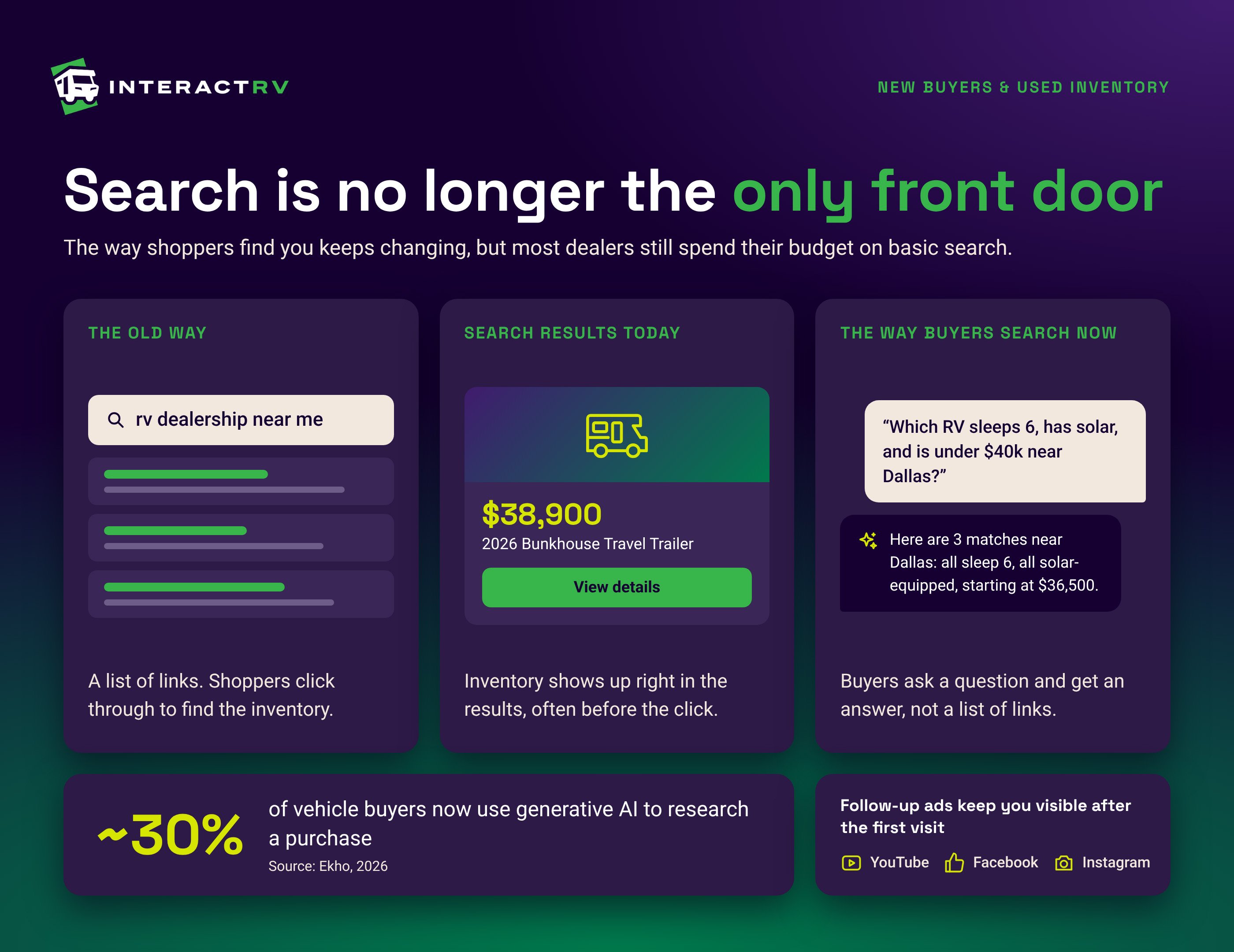
- Social platforms are where this buyer first notices you exist. YouTube, Facebook, and Instagram are where RV content and dealer presence get discovered organically, not as a sales channel in themselves, but as the front door to awareness.
- Staying in front of them matters because the first visit is rarely the only one. A shopper who lands on your site and leaves without converting isn't gone; they're mid-research. Those follow-up ads that keep showing your inventory after someone leaves your site are what keeps your dealership top of mind until they're ready to act, instead of handing that attention to whoever else shows up next.
- Search results themselves are starting to look like a storefront. Instead of a plain text ad, newer vehicle-specific ad formats let a dealer's actual inventory (real photos, real pricing, pulled straight from a live inventory feed) show up directly inside the search results page, in a premium position above standard paid search. For a shopper who already has a good idea of what they want, that's often the difference between getting the click and getting scrolled past.
- The biggest change is how the search itself works. Shoppers used to type "RV dealership near me" into Google and sort through ten blue links themselves. Increasingly, they're asking a direct question ("which RV sleeps six, has solar, and is under $40,000 near Dallas?") and expecting a direct answer, not a list to research further. Roughly 30% of vehicle buyers now use generative AI tools like ChatGPT to research a purchase, and that number is climbing fast.
- That changes what "being found" even means. When an AI tool answers a shopper's question directly, it's pulling from whichever dealership's inventory data, specs, and site content are structured clearly enough to be read and trusted by the system doing the answering. If your site isn't built for that, you're not losing a ranking position, you're not in the conversation at all.
Two different numbers are doing two different jobs here: 32 is how old new buyers are today, and 49 is the median age across the entire existing owner base, new and long-time owners combined. Both are true. Both are dropping. Neither contradicts the other.
The product side of the industry is already building for this. The current wave of RVs leaning into lithium battery systems, serious solar packages, Starlink integration, and app-controlled smart systems isn't a gimmick aimed at tech reviewers; it's a direct response to a younger buyer who expects to stay connected wherever the rig parks for the night. Manufacturers aren't guessing here. They're following the same demographic signal showing up in every stat above.
Why are new buyers and your used lot the same opportunity?
Used inventory has always run on a different calendar than new. It's a wider, less seasonal buying window, closer to a year-round pattern than a tidy spring-to-summer rush. And it's reliably sensitive to exactly the kind of pressure a 32-year-old first-time buyer, quite possibly managing a mortgage, student loans, and a newer career, is likely to be feeling: economic downturns, rising gas prices, election-year uncertainty. When that pressure rises, interest in used inventory rises with it. That buyer isn't giving up the weekend away. They're looking for a way to still afford it.
"Used inventory can be profitable at every stage — when you acquire it, when you sell it, and again through financing. Dealers who lean into it well can even pull service business away from the bigger chains nearby."
— Liz Lancaster, Regional Sales & Marketing Director, InteractRV
The catch: used inventory supply tightens right alongside the calendar's quietest stretch. When new-unit sales slow heading into the fourth quarter, fewer trade-ins come through the door, and wholesale values for towables tend to see sharper seasonal declines as buyer behavior gets more selective. The opportunity isn't just "sell more used inventory." It's "secure enough used inventory to sell," which is exactly why consignment deserves serious attention as a lower-friction supply source that doesn't depend on waiting for a trade-in to walk onto the lot.
One more obstacle has nothing to do with the market. Used units often get the least attention on the lot: photographed last, priced last, and written up on the busiest Saturday of the month. Want to know if yours does? Count the photos on your three newest used listings, then on your three newest new ones. If the gap is wide, start there. Top-turning dealers average 10.2 photos per unit, and no ad spend makes up for a listing that gives a shopper nothing to go on.
Your next RV buyer won't call first. Where are they shopping?
The bigger shift isn't which app this buyer prefers. It's how much of the buying process they'd rather handle on their own, on their own screen, before they ever pick up a phone or walk onto a lot. Calling a dealer used to be step one. For this buyer, it's closer to the last step: what they do once they've already narrowed the field themselves.
Here's what that self-serve discovery process looks like right now:
Dealers spent 20 years building for the search bar. This buyer skips it and asks ChatGPT.
Once the channel mix is right, InteractRV's own research on what RV buyers actually do online before they ever call a dealer is the natural next read, and our on-demand webinar on tailoring messaging and channels to different RV buyer types goes considerably deeper on this exact reach problem, buyer type by buyer type.
What makes RV shoppers leave a dealer website (and not come back)?
Getting found is half the job. The other half is not losing the buyer the moment they land on your site, and that half has far more texture to it than "have a decent website."
Back to that 9:14 p.m. Tuesday night. The kids are in bed. There's forty-five minutes of quiet. They pull up a few listings, trying to answer the exact questions they'd ask a salesperson in person: What does this unit cost overall? What does the inside look like? Can the whole family live in this thing comfortably for two weeks? If a listing answers those questions, they stay and keep looking. If it doesn't, they open the next tab, and they don't come back to apologize for leaving.
That moment repeats more often than most dealerships realize: more than half of dealership website traffic happens outside business hours. Your showroom lights are off, the coffee pot is cold, and somewhere a shopper is on their fourth lap through your bunkhouse listings, deciding whether you're worth a call in the morning. Most won't call until they've hit a site three, four, or five times. That means the version of a dealership's site a shopper sees on visit one has to hold up again on visit four, with nothing missing and nothing stale.
Here's what holding up looks like, in numbers pulled from InteractRV's own network of 600+ RV dealerships: among the fastest-turning dealers, 83.3% of listings include a price, units average 10.2 photos each, and fewer than 21% of inventory sits unsold past 90 days. Listings with pricing and financing information generate 47.9% more high-quality leads than listings without, because a price lets a buyer self-qualify before they ever pick up the phone, and a buyer who already knows a unit fits their budget is a far warmer conversation than one who's still guessing.
When a listing doesn't hold up, the loss is quiet: a buyer clicks through to a unit from a paid ad, finds one photo, no price, and a thin description, and leaves. A few days later, because the unit stuck in their head, they come back on their own. Nothing's changed on the page. So they leave again, this time for a dealer whose listing gave them enough to act on.
You never see this buyer leave. There's no missed call to return, no voicemail, no lost-deal note in the CRM. The only evidence is a unit that sits a little longer than it should. That buyer was ready twice. The unit wasn't the problem, and neither was the price. The page just didn't give them enough to take the next step.
Holding up across every visit, not just the first one, is also where automated follow-through earns its keep: dealers using automated email strategies see a 16.9% click-to-open rate, about three times the 5–6% benchmark, which keeps a dealership present during the weeks a buyer is quietly comparing options elsewhere. The payoff shows up at the top of the market: the top 10% of RV dealers generate 4.5 times more leads and turn inventory 54% faster than average, and the gap almost never comes from a bigger ad budget. It comes from a digital presence that didn't leave gaps for buyers to fill somewhere else.
Layer the answer-engine shift from earlier in this article on top of all of this, and the bar gets higher still. A buyer who just asked an AI tool a specific, conversational question ("What's the best bunkhouse RV for a family of four?") and got a direct answer now expects that same clarity once they land on an actual dealership's site. That shows up in two practical ways:
- The questions get more specific, and filters can't answer them. A filter can confirm a unit falls in a price range. It can't tell a shopper whether that unit has a fireplace, whether the layout fits a family of six, or whether their F-150 can tow it safely. Shoppers are increasingly asking exactly those questions directly ("Can my truck tow this fifth wheel?", "Is this layout good for full-time travel with pets?") and expecting an answer in the moment, not a callback.
- Transparency about AI matters as much as the AI itself. If a dealership's CRM or site is sending AI-generated responses, shoppers generally don't mind, but they want to know when they're talking to a tool versus a person, and they want the option to reach a human when they want one. The dealerships protecting their best relationships are the ones pairing that transparency with the fundamentals that never stopped mattering: accurate Google Business information, a healthy volume of reviews, and fast, consistent follow-up.
This is why InteractRV built its AI Search Assistant: a chat-based search tool that lets a shopper drop several criteria into one plain-language prompt ("under $75,000, sleeps six, no more than 32 feet") instead of clicking through filters and detail pages one at a time, with voice interaction built in for hands-free searching on both desktop and mobile. Shortening the distance between a shopper's first question and their first real answer is one of the highest-leverage things a dealership's website can do.
If you want to go deeper on any single piece of this, InteractRV has: the full piece on what AI search means for how dealers get found right now, the on-demand webinar on how AI is reshaping the buyer's journey, and the deeper look at why speeding up the buying process directly converts to more closed sales
How do you sell a used RV to a 32-year-old?
Six moves. Most of them work both sides of the lot at once:
- Match your used-inventory messaging to what's motivating this buyer. Affordability, remote-work readiness, and first-time-buyer accessibility, not generic "great deals" language that could apply to any product in any category. Speak to the weekend they're trying to protect, not the discount.
- Use consignment to build used inventory without waiting on trade-ins. Trade-in volume dries up heading into Q4, so go get the units yourself. By Friday, pull the ten customers who bought a towable from you longest ago and ask each one a single question: would you consider consigning it? Three "maybes" is a row of used inventory you didn't have on Monday.
- Time trade-in and "sell your RV" campaigns around economic-pressure windows (gas price spikes, rate changes, election-year uncertainty), not a flat, generic schedule. That's precisely when used-inventory interest rises. By Friday, line up the launch dates of your last three "sell your RV" campaigns against a gas price chart. If none of them landed during a spike, your campaign calendar is running on autopilot.
- Ask ChatGPT to shop your lot. Open ChatGPT and ask for a used travel trailer that sleeps six, has solar, and costs under $40,000 near you. If it recommends the dealer across town, congratulations: you've found your first fix.
- Give used inventory the same attention as new. If sales leadership quietly treats used inventory as the lesser line, that's the real bottleneck, not the marketing budget.
- Don't let the relationship end at the sale. RV owners hold onto a unit anywhere from about 5 to 20 years depending on where they are in their ownership journey, which means the buyer you reach today with all of the above is a multi-decade relationship, not a single transaction. The couple who bought a teardrop from you in 2022 should hear from you before they start shopping for a bunkhouse, not after they've chosen someone else. It deserves more than a bullet point, so treat it as the bridge to your retention strategy.

“Most RVers own their unit at least five years. It’s often 20-year financing on a purchase they’re really invested in—and it always needs something. There’s a lot of missed opportunity in the middle for dealers who are only chasing inventory turns.”
- Jenn Ouderkirk, Director of Product Strategy, InteractRV
RV shoppers keep a calendar. Do you?
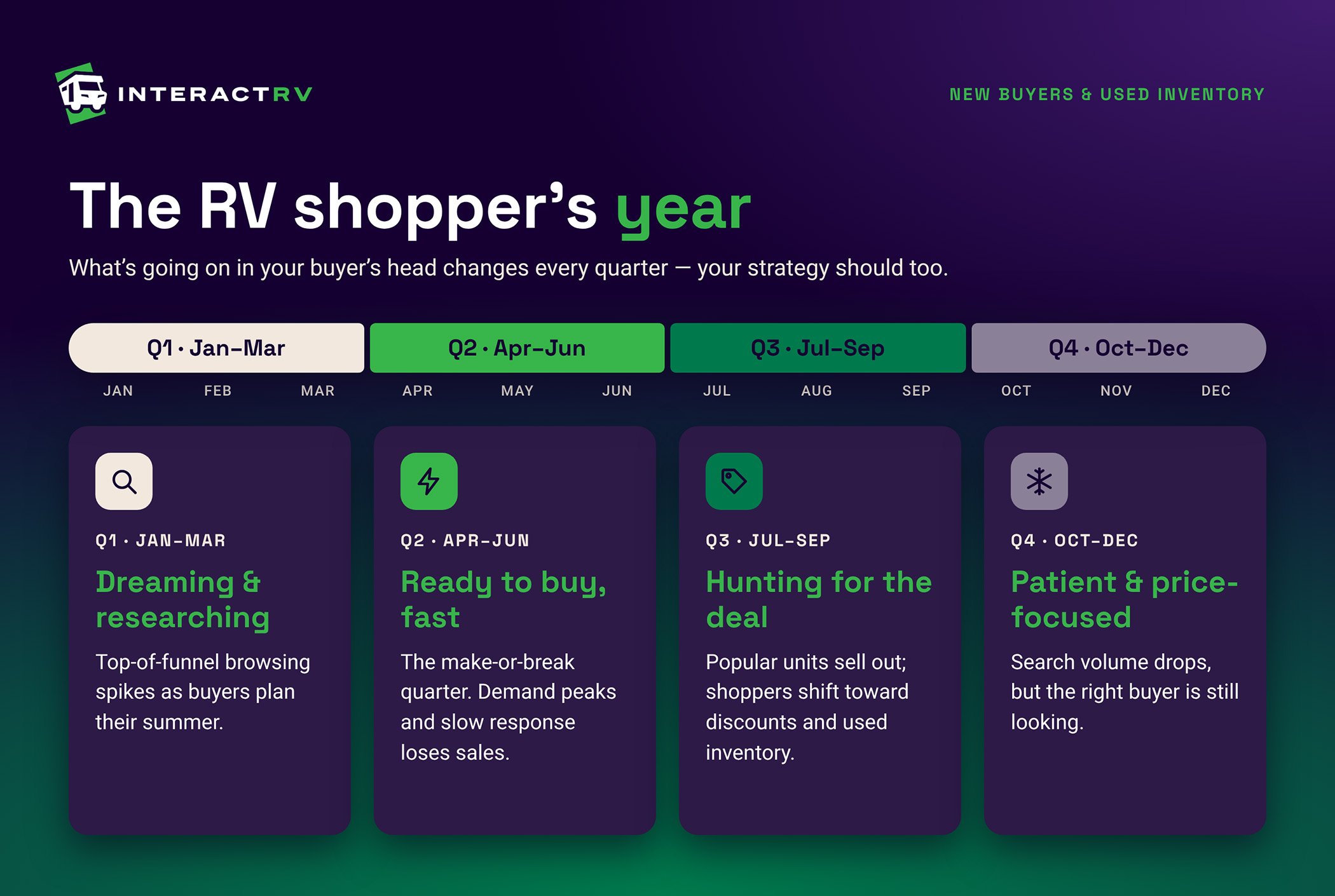
Everything above plays out differently depending on where you are in the calendar, and the shopper's mindset changes right along with it.
- January-March: Web traffic spikes as buyers dream of summer trips, but this is top-of-funnel browsing, not ready-to-buy traffic. These are long-cycle researchers. The reach strategies above matter most right here, because this is when the relationship starts.
- April-June: The make-or-break quarter. Demand for RVs peaks, and small sales teams can get overwhelmed fast, leading to slow lead response and lost sales to bigger competitors. Everything in the "what this buyer expects" section carries the highest stakes in this exact window.
- July–September: The most desirable new units sell out, dealers lean on less popular models, and aging current-year inventory starts getting discounted as winter approaches. A natural, high-leverage moment to push the used-inventory messaging from the playbook above.
- October–December: Search volume drops hard, and, as covered earlier, used-inventory supply tightens right alongside it. The buyers who are still shopping tend to be more deliberate and value-focused.
The seasonal search dip is real and shows up clearly on Google Trends, but dealers running smart, well-targeted campaigns through that window see a noticeably smaller drop in their own traffic than the broader industry trend would suggest:

"You can watch RV search interest drop off every November and December on Google Trends. But with the right campaigns running, that dip doesn't have to hit a dealer's own site anywhere near as hard."
— Nate Randall, Regional Marketing Director, InteractRV
The fundamentals behind all of this are worth a clear-eyed look heading into 2027: not uncritical optimism, but a real case for sticking with this buyer through a tougher stretch. Manufacturers have moved past the post-pandemic boom-and-bust cycle and are focusing on proven floorplans with tighter production schedules, which means dealers aren't getting stuck with bloated, unsellable inventory the way they were a few years ago. The near-term numbers are down: new RV sales fell just over 19% year-over-year, but the decline isn't even across the board. Class B and Class C motorized units, along with fifth wheels, are each holding up noticeably better than the broader market, even while still down from the year before.
That relative resilience in exactly the premium, higher-content categories this buyer gravitates toward is the more honest version of the optimism case, and the core lifestyle drivers behind RV ownership remain strong. This isn't a buyer worth chasing reluctantly. The dealers who stay in front of them now are the ones they'll remember when the market turns.
Your homework fits in one spreadsheet
The new buyer and the used-inventory buyer are, often, the same person — which means this was never really two problems. It's a channel-mix problem, a speed-of-response problem, and for some dealerships, a leadership-mindset problem. None of those require a bigger budget to fix. They require paying attention to who's showing up.
If you want to go deeper on any single piece of this, InteractRV's existing resources are built for exactly that: the RV Dealer Playbook series covers AI discovery, on-site search behavior, and long-term retention in more depth than one article can; the on-demand webinars on buyer personalization, AI's impact on the buyer journey, and using dealership data for better marketing all pick up threads this piece only had room to introduce.
First, though, open one spreadsheet: pull up your own used-inventory sales data from the last time gas prices spiked or the economy got shaky. See if the pattern above already shows up in your own numbers. It probably does.
Schedule a Demo
See Full Funnel Marketing running on your inventory.
Tell us about your dealership and we’ll walk you through the funnel, end to end, with your own units in the examples.
-
 A 30-minute walkthrough, no slide deck
-
A look at how your current feed would run in ads
-
Straight answers on scope, timing, and spend
Book your 30-minute demo
Thanks for submitting the form.